The global stock market is one of the most powerful wealth-building systems ever created. From Wall Street in New York to the financial centers of London, Hong Kong, and Shanghai, stock exchanges connect millions of investors with thousands of companies. Understanding how stock exchanges and market indexes work is essential for anyone who wants to build long-term financial success through investing.

This guide explains the structure of global stock exchanges, the role of market indexes, and the long-term performance of major stock markets. Whether you are a beginner or an experienced investor, mastering these concepts will help you make smarter investment decisions and build a stronger portfolio.
Understanding Stock Exchanges
A stock exchange is a marketplace where investors buy and sell shares of publicly traded companies. These exchanges provide a regulated and transparent environment that allows businesses to raise capital and investors to participate in company growth.
The United States has one of the largest and most developed stock markets in the world, with more than 30 stock exchanges. The most important include the New York Stock Exchange (NYSE), the American Stock Exchange (AMEX), and the Nasdaq Stock Exchange. These exchanges collectively list thousands of companies from various sectors, including technology, finance, healthcare, energy, and consumer goods.

In addition to the United States, several major global stock exchanges play a crucial role in the world economy. The Shanghai Stock Exchange and Hong Kong Stock Exchange represent major financial centers in Asia. The London Stock Exchange is one of Europe’s largest and most influential markets, while the Tokyo Stock Exchange dominates Japan’s financial landscape.
Together, these exchanges create a global network that allows capital to flow across borders and provides investors with opportunities to diversify internationally.
The Importance of Market Indexes
While stock exchanges list thousands of companies, investors need a way to measure overall market performance. This is where market indexes play a critical role. A stock market index tracks the performance of a selected group of stocks and provides a snapshot of how a market or sector is performing.
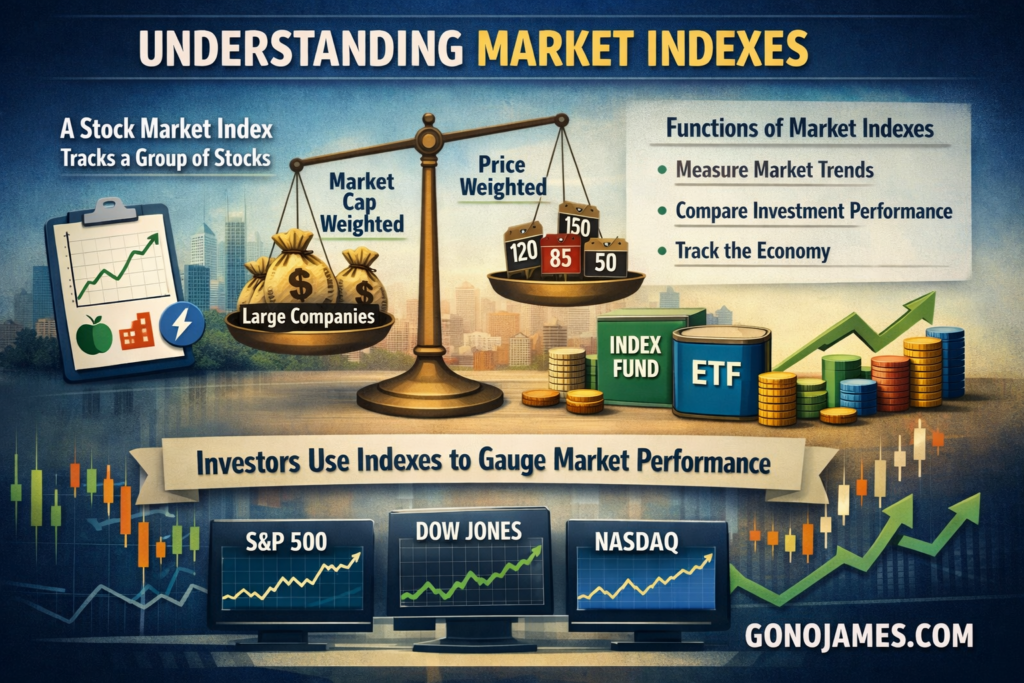
Indexes are typically calculated using a weighted average of the stocks included in the index. Some indexes are weighted by market capitalization, meaning larger companies have more influence on the index. Others, like the Dow Jones Industrial Average, are price-weighted.
Market indexes serve several important functions. They help investors measure market trends, compare investment performance, and understand the overall direction of the economy. Many investors also use index funds and exchange-traded funds (ETFs) to invest directly in these indexes.
Major U.S. Stock Market Indexes
The United States is home to three of the most widely followed stock market indexes in the world.
The Dow Jones Industrial Average is one of the oldest and most recognized indexes. It consists of 30 large, well-established companies that represent key sectors of the U.S. economy. These companies are considered blue-chip stocks and include leaders in technology, finance, healthcare, and consumer products.

The S&P 500 Index includes 500 of the largest publicly traded companies in the United States. It is widely regarded as the best indicator of overall U.S. stock market performance because it covers a broad range of industries and represents a significant portion of total market value.
The Nasdaq Composite Index tracks all stocks listed on the Nasdaq exchange, with a heavy focus on technology companies. It includes thousands of stocks and is often used to measure the performance of growth and innovation-driven sectors.
These three indexes provide investors with a comprehensive view of the U.S. stock market and serve as benchmarks for professional and individual investors worldwide.
Long-Term Performance of Major Markets
Historical data shows that stock markets tend to rise over the long term despite short-term volatility. Over the past several decades, major global indexes have delivered strong compounded annual growth rates.
The Dow Jones Industrial Average has produced an average annual return of approximately 11 percent over a 30-year period, including dividends. This demonstrates the power of long-term investing and the importance of staying invested through market cycles.
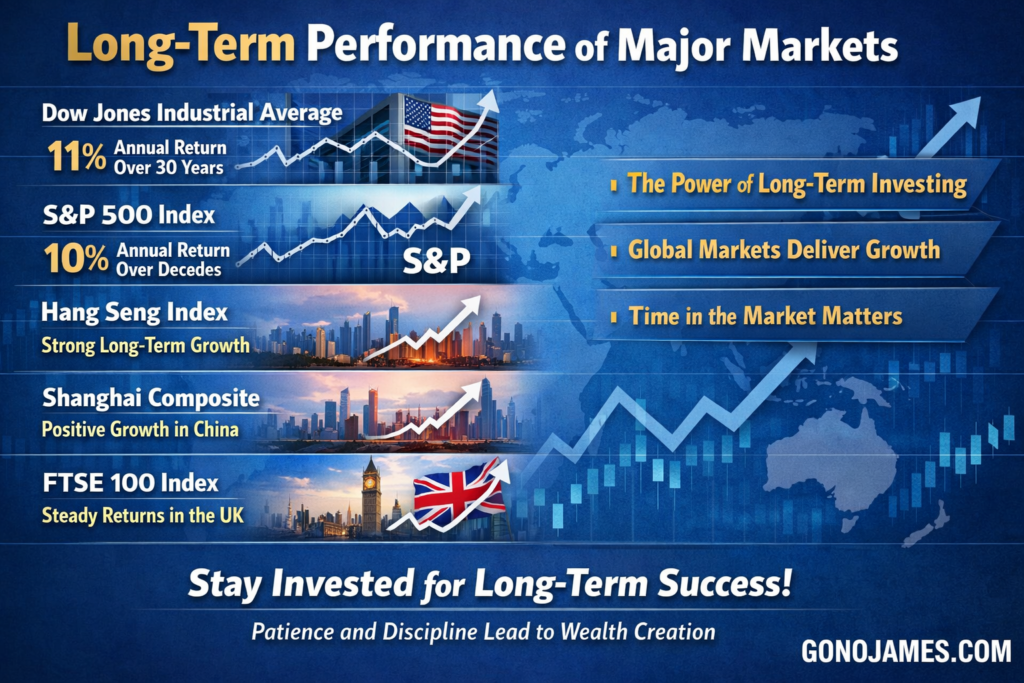
The S&P 500 has delivered similar results, with long-term annual returns around 10 percent. Investors who consistently invested in this index over several decades experienced substantial wealth growth through both capital appreciation and dividend income.
International markets have also shown strong performance. The Hong Kong Hang Seng Index has generated solid long-term returns, reflecting the growth of Asian economies and global trade. The Shanghai Composite Index, despite periods of volatility, has delivered positive long-term growth as China’s economy expanded. The London FTSE 100 has provided steady returns supported by global multinational companies and dividend income.
These results highlight a key principle of investing: time in the market is more important than timing the market. Investors who remain patient and focused on long-term growth are more likely to achieve consistent returns.
Why Long-Term Investing Works
The stock market rewards discipline, patience, and consistency. Over time, economic growth, corporate profits, and innovation drive stock prices higher. Dividends further enhance returns by providing regular income that can be reinvested to compound wealth.
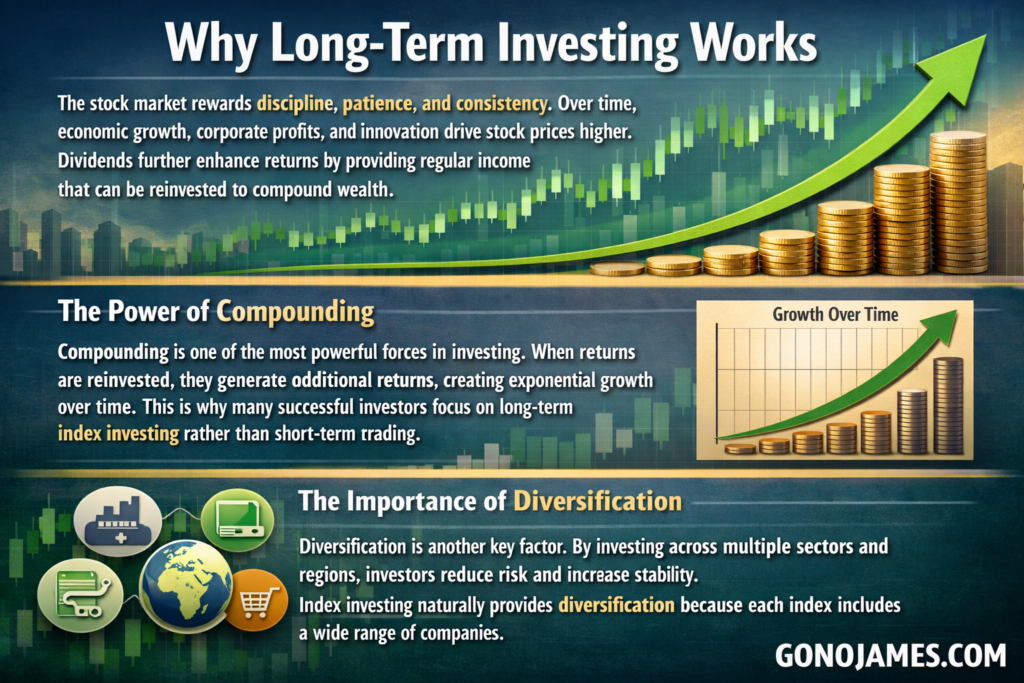
Compounding is one of the most powerful forces in investing. When returns are reinvested, they generate additional returns, creating exponential growth over time. This is why many successful investors focus on long-term index investing rather than short-term trading.
Diversification is another key factor. By investing across multiple sectors and regions, investors reduce risk and increase stability. Index investing naturally provides diversification because each index includes a wide range of companies.
Building a Smart Investment Strategy
Successful investing begins with understanding the market structure and selecting the right approach. Many investors choose index investing because it offers simplicity, diversification, and consistent long-term performance.
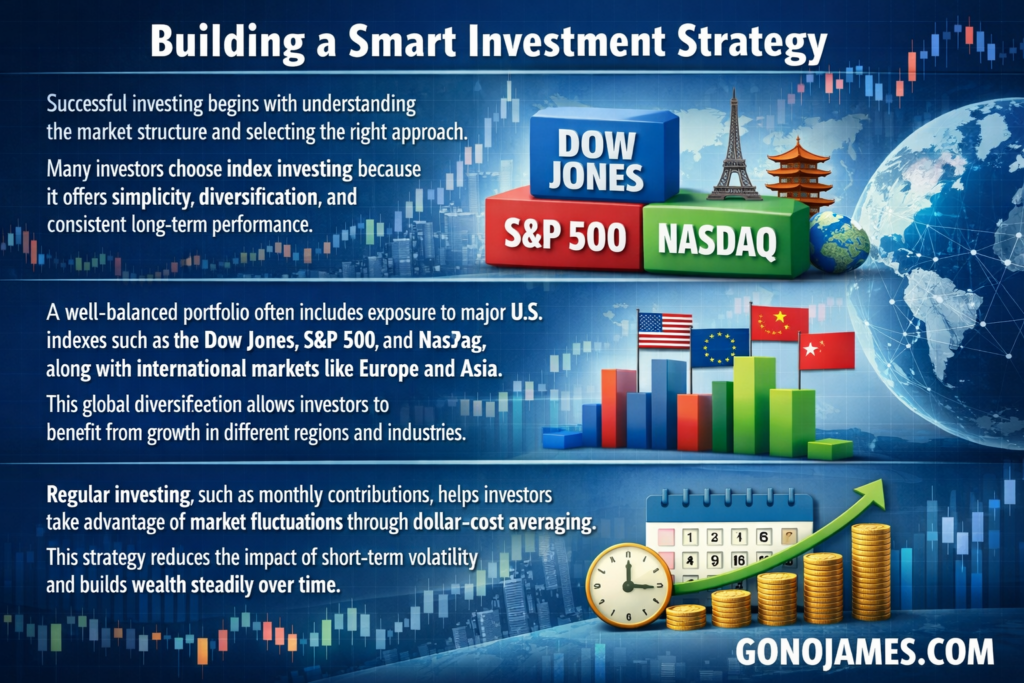
A well-balanced portfolio often includes exposure to major U.S. indexes such as the Dow Jones, S&P 500, and Nasdaq, along with international markets like Europe and Asia. This global diversification allows investors to benefit from growth in different regions and industries.
Regular investing, such as monthly contributions, helps investors take advantage of market fluctuations through dollar-cost averaging. This strategy reduces the impact of short-term volatility and builds wealth steadily over time.
Conclusion
Stock exchanges and market indexes form the foundation of global investing. They provide opportunities for individuals to participate in the growth of leading companies and economies around the world. By understanding how these systems work and focusing on long-term strategies, investors can build sustainable wealth and achieve financial independence.
The history of global markets shows that disciplined investors who remain patient and diversified are consistently rewarded. Whether investing in the United States, Asia, or Europe, the principles of long-term investing remain the same: stay informed, stay consistent, and allow time and compounding to work in your favor.
Mastering the fundamentals of stock exchanges and index investing is the first step toward becoming a confident and successful investor in today’s global financial markets.