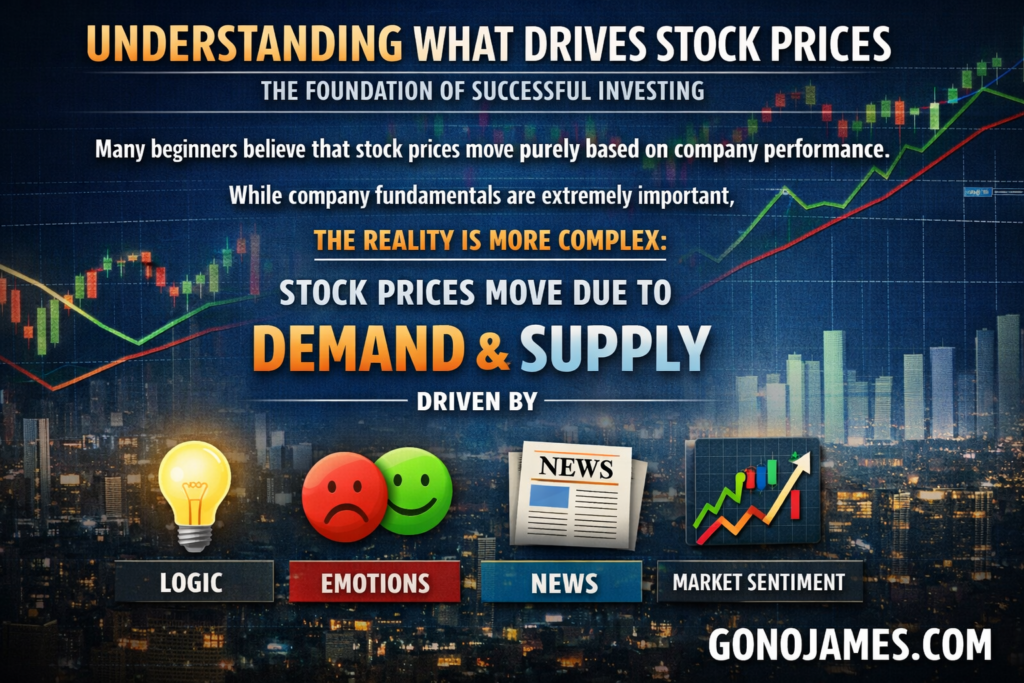
Understanding what drives stock prices is one of the most important foundations of successful investing. Many beginners believe that stock prices move purely based on company performance. While company fundamentals are extremely important, the reality is more complex. Stock prices move due to demand and supply, and demand and supply are driven by logic, emotions, news, and market sentiment.
To become a successful investor, you must understand both the short-term and long-term forces that move stock prices. When you master this concept, you gain a powerful advantage in the financial markets.
Demand and Supply: The Core Driver of Stock Prices
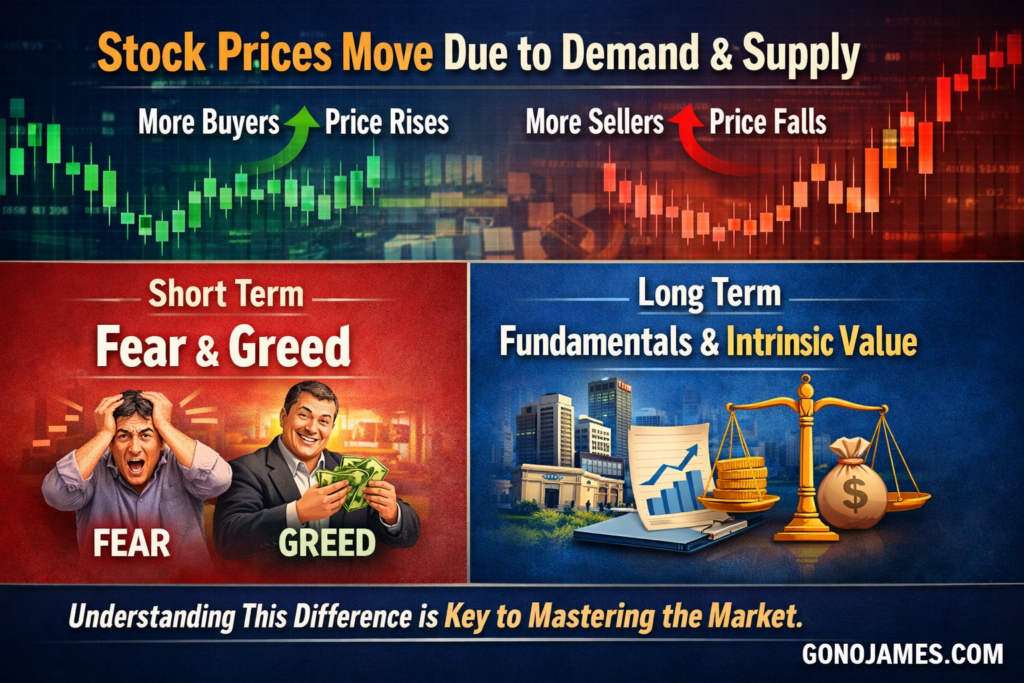
At its most basic level, stock prices move because of demand and supply. When more investors want to buy a stock than sell it, the price rises. When more investors want to sell than buy, the price falls.
However, what causes investors to buy or sell? This is where logic and emotions come into play.
In the short term, buying and selling decisions are heavily influenced by emotions such as fear and greed. In the long term, they are influenced by company fundamentals and intrinsic value.
Understanding this difference is key to mastering the market.
Short-Term Price Movements: Driven by Emotions and Trends
In the short term, stock prices often behave irrationally. Prices can move 20% to 50% higher or lower even when nothing significant changes in the company’s core business.
Why does this happen?
Short-term price movements are driven by market sentiment, news, and trends. Investors react quickly to headlines, economic data, rumors, and global events. Fear can cause panic selling, while greed can cause aggressive buying.
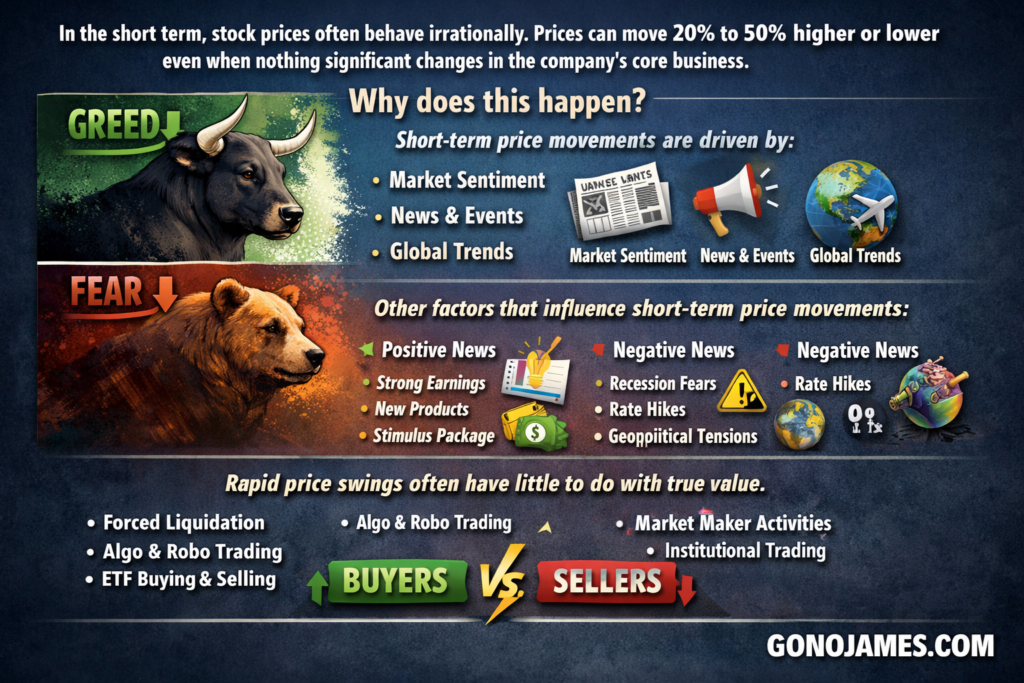
For example, positive news such as strong earnings reports, new product launches, or economic stimulus packages can push prices higher. On the other hand, negative news such as recession fears, interest rate hikes, or geopolitical tensions can push prices lower.
Other factors that influence short-term price movements include:
- Forced liquidation from margin calls
- Algorithmic and robo trading
- ETF buying and selling
- Market maker activities
- Institutional trading
These forces can create rapid price swings that have little to do with the true value of a company.
This is why asking “why did the market move today?” is often irrelevant. Analysts will always find a reason after the fact, but the real driver is the continuous battle between buyers and sellers.
Long-Term Price Movements: Driven by Fundamentals
While short-term prices are emotional, long-term prices are logical. Over time, stock prices follow company fundamentals and intrinsic value.
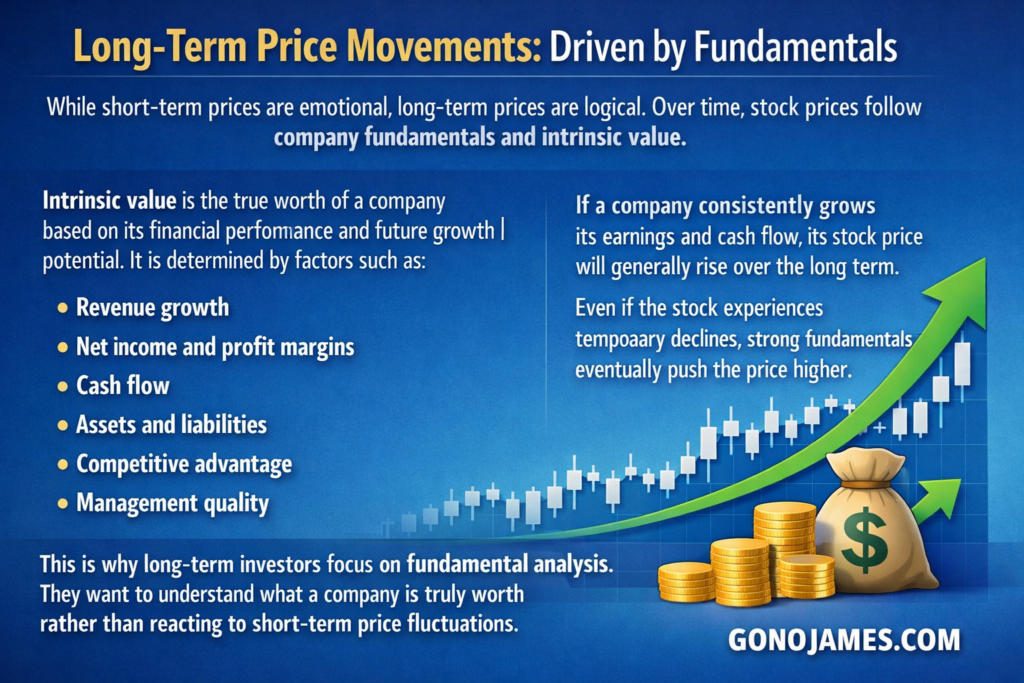
Intrinsic value is the true worth of a company based on its financial performance and future growth potential. It is determined by factors such as:
- Revenue growth
- Net income and profit margins
- Cash flow
- Assets and liabilities
- Competitive advantage
- Management quality
If a company consistently grows its earnings and cash flow, its stock price will generally rise over the long term. Even if the stock experiences temporary declines, strong fundamentals eventually push the price higher.
This is why long-term investors focus on fundamental analysis. They want to understand what a company is truly worth rather than reacting to short-term price fluctuations.
Fundamental Analysis vs Technical Analysis
To maximize investing success, you need to understand both fundamental analysis and technical analysis.
Fundamental analysis focuses on determining what a stock is worth. Investors analyze financial statements, earnings growth, and company performance to estimate intrinsic value.
Technical analysis focuses on price trends and market behavior. Traders analyze charts, patterns, and indicators to determine whether a stock is in an uptrend, downtrend, or consolidation phase.
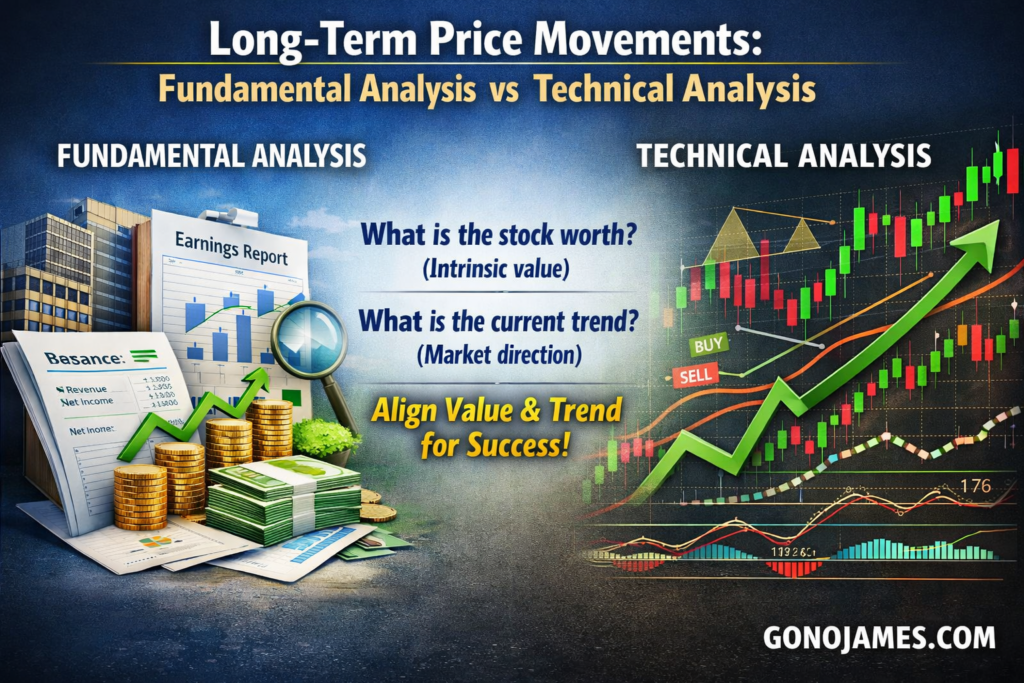
Smart investors combine both approaches.
They ask two critical questions:
- What is the stock worth? (Intrinsic value)
- What is the current trend? (Market direction)
When both value and trend align, the probability of success increases significantly.
Price Is Not Value
One of the most important principles in investing is understanding that price is not value.
Price is what you pay. Value is what you get.
A stock can be overpriced even if the company is great. Similarly, a stock can be undervalued even if the company is strong.
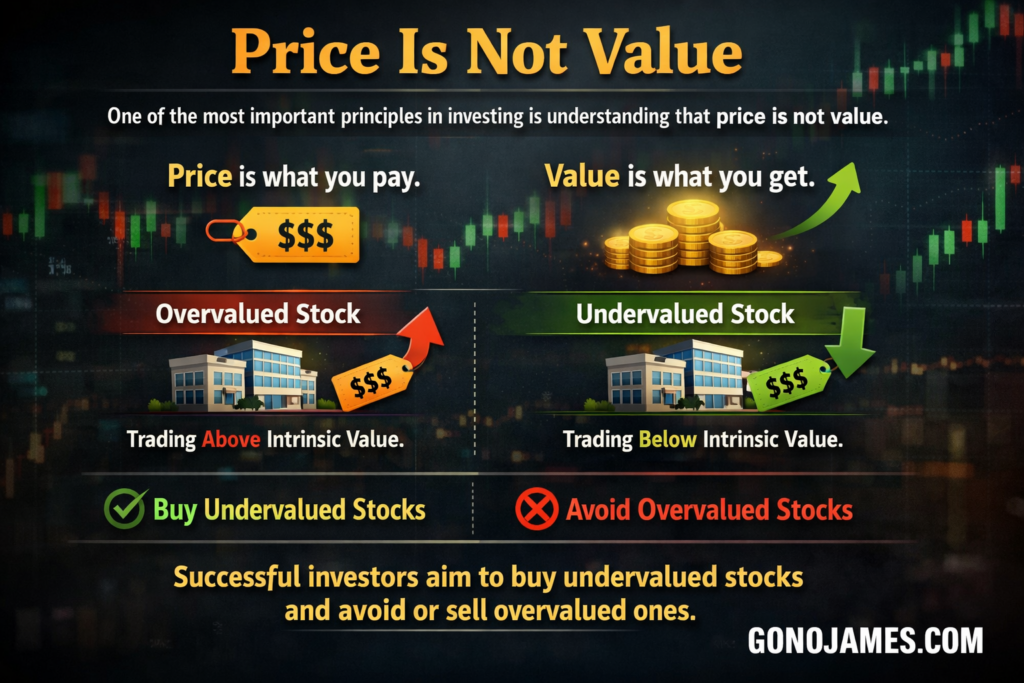
When a stock trades below its intrinsic value, it is considered undervalued. When it trades above intrinsic value, it is considered overvalued.
Successful investors aim to buy undervalued stocks and avoid or sell overvalued ones.
Using Valuation Metrics: PE and PEG Ratios
Two popular tools for evaluating stock valuation are the PE ratio and PEG ratio.
The Price-to-Earnings (PE) ratio measures how much investors are willing to pay for each dollar of earnings. A PE ratio of 15 means investors are paying $15 for every $1 of annual profit.
A general rule is that a fairly valued company’s PE ratio should roughly match its earnings growth rate. For example, if a company has a PE of 15, it should ideally grow earnings at about 15% per year.
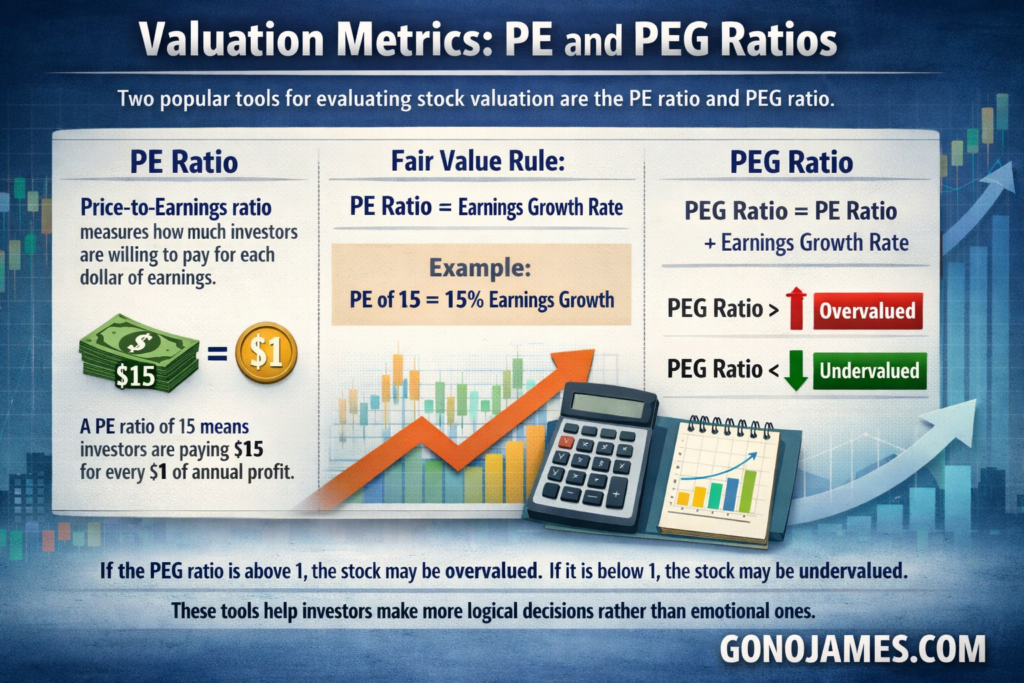
The PEG ratio takes this concept further. It is calculated as:
PEG Ratio = PE Ratio ÷ Earnings Growth Rate
If the PEG ratio is above 1, the stock may be overvalued. If it is below 1, the stock may be undervalued.
These tools help investors make more logical decisions rather than emotional ones.
How Stocks Build Long-Term Wealth
Investing in stocks is one of the most powerful ways to build long-term wealth. There are two primary ways investors make money from stocks:
1. Capital Appreciation
This occurs when the stock price increases. If you buy a stock at $50 and sell it at $100, you earn a capital gain of $50 per share.
2. Dividends
Some companies distribute a portion of their profits to shareholders in the form of dividends. Dividend-paying stocks provide passive income and long-term stability.
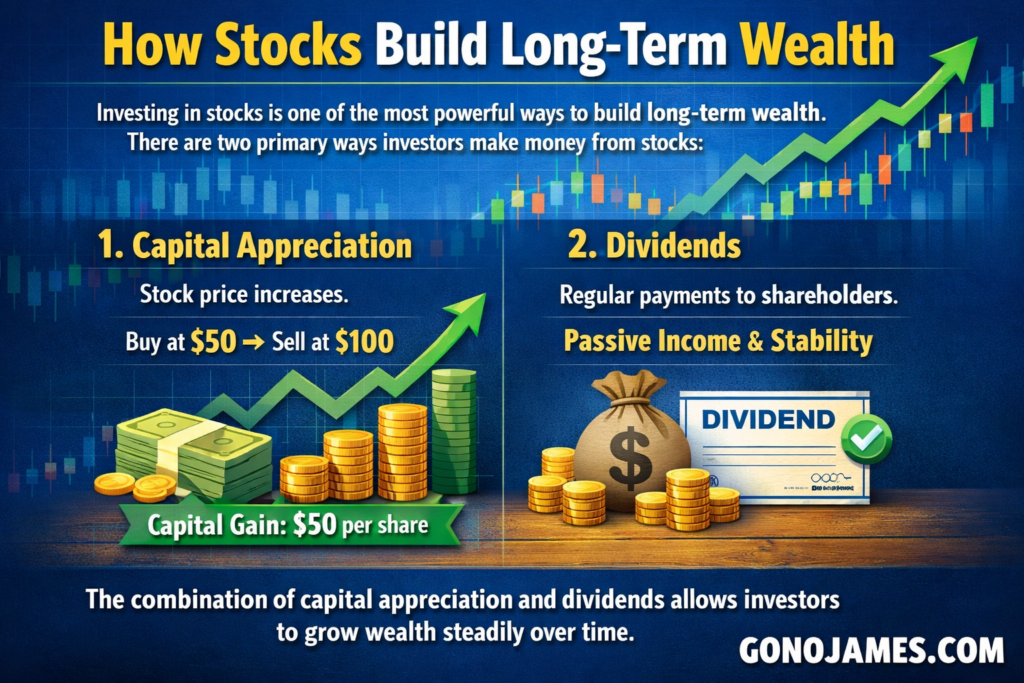
The combination of capital appreciation and dividends allows investors to grow wealth steadily over time.
Smart Investing Strategy
To succeed in the stock market, investors should follow a simple but powerful strategy:
- Buy undervalued stocks in an uptrend
- Wait when undervalued stocks are still falling
- Sell or avoid overvalued stocks in downtrends
- Trade carefully when stocks are overvalued but trending up
This approach combines value investing with trend analysis, giving investors a balanced and disciplined framework.
Final Thoughts
Stock prices move because of demand and supply, but demand and supply are driven by both logic and emotions. In the short term, emotions dominate. In the long term, fundamentals prevail.
Successful investors understand this difference and use it to their advantage. They ignore short-term noise, focus on intrinsic value, and align their investments with long-term trends.
If you truly want to master investing and build lasting wealth, you must understand what drives stock prices — not just today, but over time.